

Illustration by Thomas Denton
authors note : yeah I know the Northern Rockhopper Penguin (icon) isn't on the palmer penguins dataset, it just looks really cool lol, it looks like a mad scientist penguin - my kinda penguin!
How many penguins can TabPFN classify correctly?
TabPFN is a supervised classification/regression analysis dataset that focuses on tabular datasets (focusing on small-to-medium datasets), the paper claims SOTA performance, in this article I test out TabPFNs accuracy on the palmer penguins dataset, and give a basic explaination of how it works.
Testing it out on the Palmer penguins dataset
The palmer penguins dataset is a dataset on penguins and some of the lengths of the "features" of those penguins
from their documentation, a basic look at their features shows this
str(penguins)#> tibble [344 × 8] (S3: tbl_df/tbl/data.frame)#> $ species : Factor w/ 3 levels "Adelie","Chinstrap",..: 1 1 1 1 1 1 1 1 1 1 ...#> $ island : Factor w/ 3 levels "Biscoe","Dream",..: 3 3 3 3 3 3 3 3 3 3 ...#> $ bill_length_mm : num [1:344] 39.1 39.5 40.3 NA 36.7 39.3 38.9 39.2 34.1 42 ...#> $ bill_depth_mm : num [1:344] 18.7 17.4 18 NA 19.3 20.6 17.8 19.6 18.1 20.2 ...#> $ flipper_length_mm: int [1:344] 181 186 195 NA 193 190 181 195 193 190 ...#> $ body_mass_g : int [1:344] 3750 3800 3250 NA 3450 3650 3625 4675 3475 4250 ...#> $ sex : Factor w/ 2 levels "female","male": 2 1 1 NA 1 2 1 2 NA NA ...#> $ year : int [1:344] 2007 2007 2007 2007 2007 2007 2007 2007 2007 2007 ...I've installed TabPFN as described in the tabpfn documentation (note : you've to accept their license and export the reqired environmental variables before usage) and Palmer penguins with a simple pip install palmerpenguins
Note : The colab notebook where I am trying this out is available here
The interface to access TabPFN is the same as most sklearn models, easy to import
import numpy as npfrom palmerpenguins import load_penguinsfrom sklearn.model_selection import train_test_splitfrom sklearn.ensemble import HistGradientBoostingClassifierfrom tabpfn import TabPFNClassifierload the dataset, appropriately assign the features and the target variable
df = load_penguins().dropna(subset=["species"])y = df["species"]X = df.drop(columns=["species"])for c in ["island", "sex"]: X[c] = X[c].astype("category").cat.codes.replace(-1, np.nan)setup a nice train test split
X_tr, X_te, y_tr, y_te = train_test_split(X, y, test_size=0.3, stratify=y)n = len(X_te)and predict the output code to test out the accuracy
clf = TabPFNClassifier().fit(X_tr, y_tr)print(f"Accuracy of TabPFN - {(clf.predict(X_te) == y_te).sum()}/{n}")on a bonus, the interface is really neat and straightforward, anyone with proir sklearn experience is going to grab on this instantly
and one gets 104/104 which….doesn't tell us much, but when I push lower and test this out on lower values and compare this against a historical gradient boosting classifier
with
for k in [10, 20, 40, 80, 160]: Xs, ys = train_test_split(X_tr, y_tr, train_size=k, stratify=y_tr)[::2] t = (TabPFNClassifier().fit(Xs, ys).predict(X_te) == y_te).sum() g = (HistGradientBoostingClassifier().fit(Xs, ys).predict(X_te) == y_te).sum() print(f"{k:>3} penguins TabPFN {t}/{n} GBM {g}/{n}")I get
10 penguins TabPFN 102/104 GBM 46/104 20 penguins TabPFN 103/104 GBM 46/104 40 penguins TabPFN 104/104 GBM 91/104 80 penguins TabPFN 104/104 GBM 102/104160 penguins TabPFN 104/104 GBM 104/104oh yeah, much better, TabPFN can instantly understand penguins
So what is TabPFN anyway
so the TabPFN 3 archiv article gets nicely into how TabPFN behaves
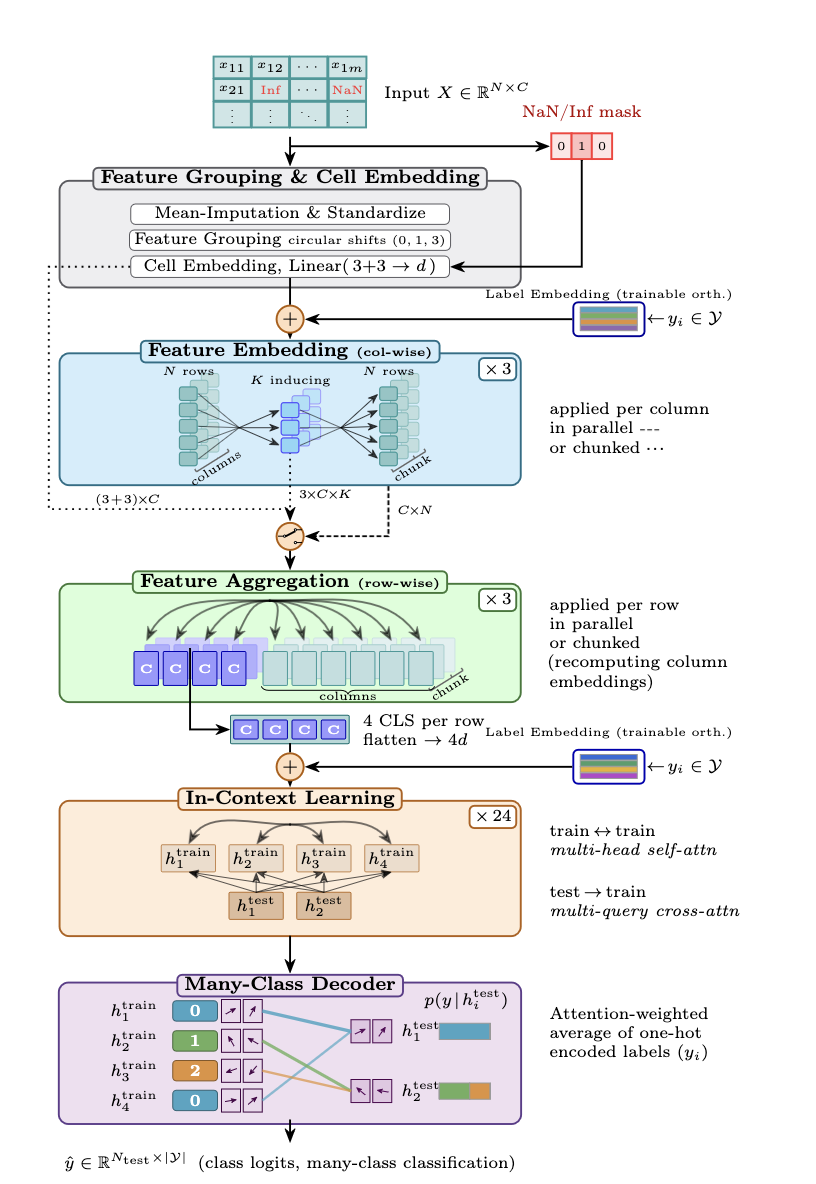
okay here's a more simple explaination to how this model really works
So the model does "in-context" learning, unlike other things it's not really truly "trained" on the data, it sorta observes the data and produces an answer.
The model is a transformer model (they also do have a "thinking variant", I suspect thinking means something different in this context as to what it means with LLMs, the paper doesn't get into what thinking mode really is)
When you are doing inference, it essentially converts all the values into a vector, and then the transformer compares the rows against each other (and this reduces the amount of computational time, since technically everything is looking at "one vector")
but that's basically it,
there are some more neat tricks that it uses (that you can read more about in their paper https://arxiv.org/pdf/2605.13986), like row chunking to classify multiple rows at the same time, some neat KV cache optimization tricks
but, really, the underlying architecture is so beautiful and simple - and very effective
Effectiveness
They've some details of proof, it seems to do better on causal inference
on the tabarena leaderboard
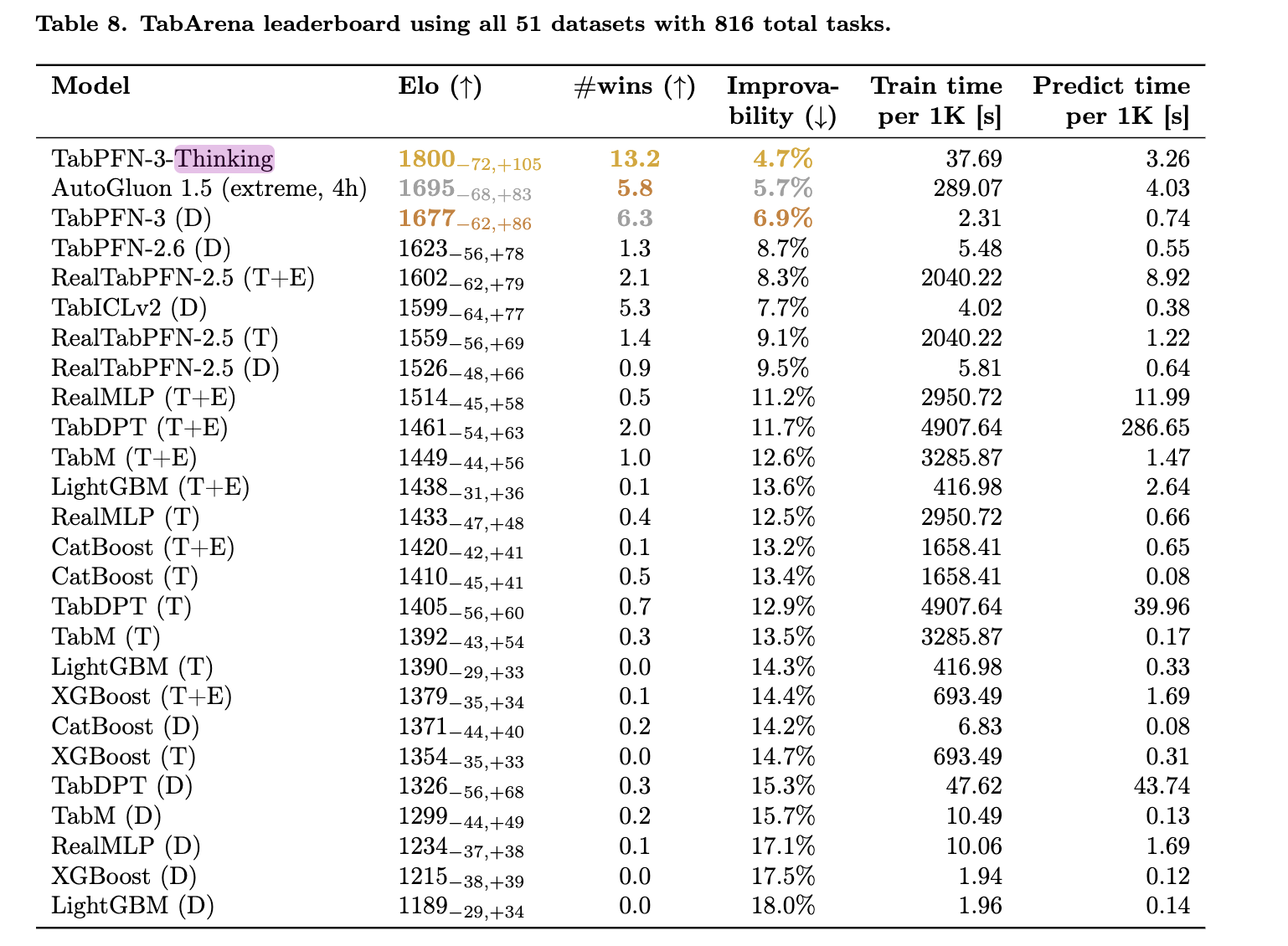 the model does seem to produce state of the art of an ELO
on the TALENT benchmark
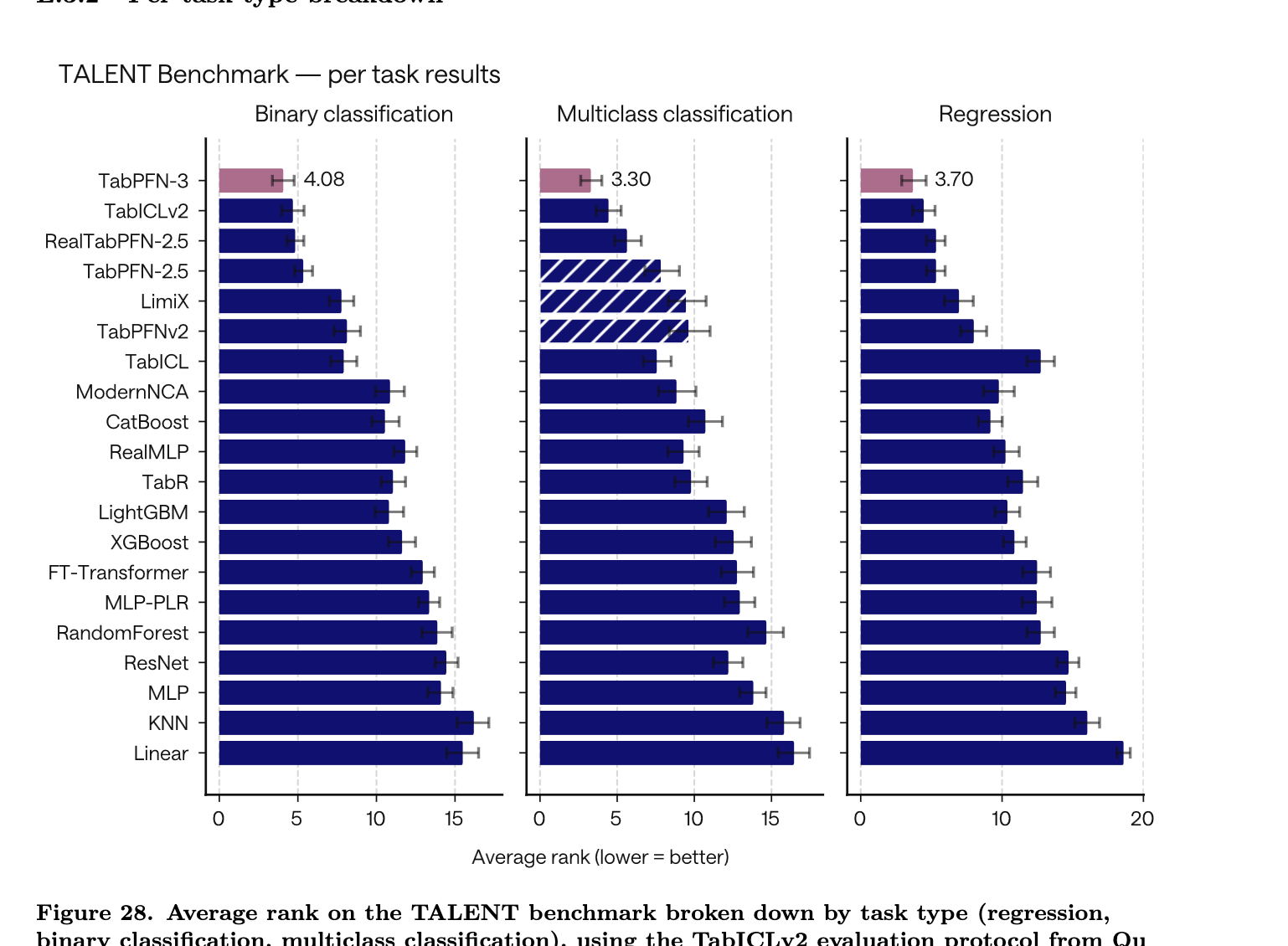
I am to be honest, a little blown away by how such a simple model performs so effectively
xoxo - appreciate you
Contents
Related

Autonomously control robots with lerobot and runpod!
Tue · Aug 11, 2026

Zero-shot use the SO101 with ArUco tags!
Mon · Jul 20, 2026

No don't google it, ask me about it
Sat · Jul 18, 2026

The collective ownership costs for LLMs - 2026 June
Sat · Jun 20, 2026

You're valuable, I'm valuable, the world is weird
Sun · Nov 2, 2025